
As a professional genealogist with a solid background in genetic genealogy, I’ve worked on numerous client projects that involved interpreting DNA test results. Over the past decade, DNA testing has become one of the most powerful tools in family history research — offering breakthroughs where the paper trail runs cold, confirming relationships, and even opening doors to unknown branches of your family tree.
If you’re new to genealogy research or haven’t researched in a long time (before DNA tests were available), this guide will walk you through the essentials. I’ll explain the different types of DNA tests available, what you can learn from each, and how major testing companies compare. Importantly, I’ll also share my professional perspective on which tests provide the most value for genealogical purposes.
What is a DNA Test, and What Can It Reveal?
DNA testing for genealogy works by analyzing the genetic material you inherit from your ancestors. When you take a test, you’ll receive a breakdown of your ethnicity estimates, a list of DNA matches (relatives who share some of your DNA), and sometimes even insights into inherited traits. The tests are simple and painless. Depending on the test, you either spit into a tube or use a cheek swab. No needles. No blood.
Types of DNA Tests: Autosomal, mtDNA, and Y-DNA
When people talk about “taking a DNA test,” they often don’t realize there are different kinds of DNA tests, each with its own purpose and strengths. Understanding these differences is key to selecting the right test for your genealogical goals.
Autosomal DNA (atDNA)
This is the most common type of DNA test used for genealogy. Autosomal DNA tests examine your 22 pairs of non-sex chromosomes, which you inherit from both parents. Because you get roughly 50% of your autosomal DNA from each parent — and about 25% from each grandparent — it’s great for identifying matches across all branches of your family tree, typically within the past 5 to 7 generations.
Best for:
- General family history research
- Finding DNA matches from all ancestral lines
- Exploring ethnicity estimates (with caveats)
- Confirming documented relationships
An autosomal test is the first test I recommend that you take. Any other (optional) DNA test you take builds on what you learn from this test. Every major testing company offers autosomal DNA testing (more on this in a bit).
Mitochondrial DNA (mtDNA)
This test looks at mitochondrial DNA, which is passed from mothers to their children. However, only daughters pass it on to the next generation. That means mtDNA follows your direct maternal line—your mother, her mother, her mother’s mother, and so on.
While mtDNA mutates slowly, making it less helpful for recent genealogy, it can confirm maternal line relationships or help identify deep ancestral origins many hundreds or even thousands of years back.
Best for:
- Tracing deep maternal ancestry
- Confirming matrilineal relationships
- Connecting to ancient haplogroups
Currently, FamilyTreeDNA (FTDNA) is the only major company offering standalone mtDNA testing.
Important note: Both females and males can take the mtDNA test to discover more about their maternal line.
Y-DNA
Y-DNA is passed from father to son, virtually unchanged except for occasional mutations. It traces your direct paternal line—your father, his father, and so on. Only biological males (assigned male at birth) can take a Y-DNA test, but females can access this information by testing a father, brother, or paternal uncle.
Y-DNA is especially powerful for surname studies and identifying distant paternal line relatives. It’s also valuable in cases of unknown paternity or when trying to connect male lines separated by time or migration.
Best for:
- Tracing direct paternal ancestry
- Surname projects and patrilineal research
- Brick-wall breakthroughs in male lines
Again, FTDNA is the leading provider for Y-DNA testing.
What a DNA Test Can Tell You
Now that you understand the types of DNA tests, let’s talk about what you actually get when you test — because it’s much more than just a colorful pie chart of your ethnic background.
Ethnicity Estimates
One of the first things people notice after testing is their ethnicity estimate. While this can be fun and sometimes surprising, it’s important to treat these results as estimates, not absolute truths. These estimates are based on comparing your DNA to reference populations, and they can vary widely between companies.
Ethnicity results can give clues about broad regional ancestry and migration patterns, especially when paired with documented history. However, they’re usually too general for detailed genealogical conclusions.
Pro tip: Ethnicity results often change over time as companies update their algorithms and add reference populations. Don’t get too attached to specific percentages. If they change, it doesn’t mean that your DNA test is “wrong.” If you take multiple DNA tests, you’ll notice that the percentages differ slightly between companies. For example, MyHeritage says I’m 27.2% Swedish whereas Ancestry calculates it at 20% (for now).

DNA Matches
In my professional experience, your list of DNA matches is the most important tool for discovering more about your ancestors. Autosomal DNA tests connect you to living relatives — second, third, fourth cousins and beyond — who share segments of DNA with you. These matches can:
- Confirm family relationships
- Identify unknown ancestors
- Connect you with family members around the world
- Help resolve adoption and misattributed parentage cases
Each testing company offers tools to explore these matches. Some are more robust than others, as I’ll cover below.
Ancient Origins
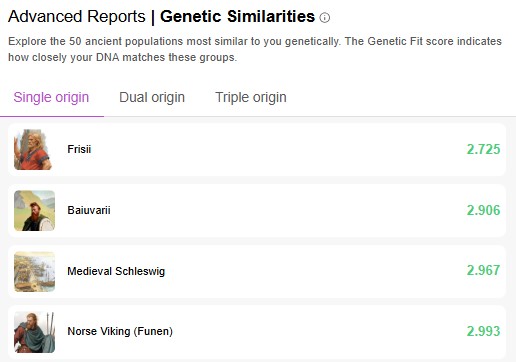
If you take a test through MyHeritage, you will also receive information about your ancient origins. Essentially, this is a way to discover more about your origins from thousands of years ago before modern records were kept. For example, this feature was able to tell me more about my Viking and Celtic ancestors, among others. If archaeology fascinates you as much as it does me, ancient origins should intrigue you.
While this isn’t directly useful for building a family tree, it can enhance your understanding of your deep ancestry and may provide supporting evidence in some research cases.
Traits and Health Reports
Some companies include reports on physical traits (like eye color or caffeine sensitivity), wellness, or health-related genetic markers. For example, Ancestry’s traits feature says that I like to dance, am motivated by success, and have dark hair and blue eyes. All true! Unfortunately, it also indicates that I’m less attractive to mosquitoes. I only wish that were true! In general, I found most of the traits accurate, but this is really more of a “fun” feature than anything you can use for serious genealogy research.
Choosing a DNA Testing Company: Pros and Cons
With several companies offering DNA tests, choosing the right one can be overwhelming. Here’s my professional breakdown of the main options I recommend for genealogical research.
Ancestry
Ancestry is the largest DNA testing company and offers autosomal DNA tests. It is ideal for both beginners and experienced genealogists as well or anyone looking to identify biological relatives.
Strengths:
- Excellent match list and user-friendly interface
- Strong family tree integration
- DNA ThruLines tool helps visualize shared ancestors
- Large and growing number of U.S. and international users
Limitations:
- No Y-DNA or mtDNA testing
- No chromosome browser for segment-level analysis
As a genealogist, I find AncestryDNA’s match list and family tree tools extremely helpful, particularly for resolving unknown parentage or collaborating with distant cousins.
MyHeritage
MyHeritage also offers an autosomal DNA test. Its database of users is smaller than that of Ancestry but it is useful for those looking for matches overseas, particularly in Europe. For example, my mother’s family are more recent immigrants from Europe and I found many more matches to her family on MyHeritage than on Ancestry. This led to some exciting in-person meetings with distant cousins from France and Sweden the last time I traveled to Europe.
Strengths:
- Excellent for international matches, especially in Europe and Israel
- Affordable pricing and frequent sales
- Good chromosome browser for segment comparison
- Auto-clustering and ethnicity estimate tools
- Extensive ancient origins data
Limitations:
- Smaller database than Ancestry
- Tree-building features are less advanced, and hints are not as robust

FamilyTreeDNA (FTDNA)
FamilyTreeDNA offers autosomal, mtDNA, and Y-DNA tests. It’s ideal for serious genealogists, male-line researchers, and those pursuing deep maternal or paternal ancestry. That said, it’s not what I would recommend for a first-time test taker.
Strengths:
- Only major provider of comprehensive Y-DNA and mtDNA testing
- Great for surname and haplogroup studies
- Segment-level analysis and project tools
Limitations:
- User interface is more technical and less intuitive
- Smaller autosomal match database compared to Ancestry and MyHeritage
As a genetic genealogist, I frequently use FTDNA for Y-DNA testing in surname projects and brick-wall cases, especially when dealing with paternal line mysteries. Their deep-level mtDNA test is also unmatched for maternal lineage analysis.
Pro Tip: Many people have asked me recently about testing with 23andMe. Because of their recent bankruptcy and concerns over the long-term future of this company, I don’t currently recommend testing with 23andMe. If this changes, I will update this post.
The Best DNA Test: Final Thoughts
Choosing the best DNA test for genealogy depends on your goals. For most people starting out, AncestryDNA offers the most matches and the best integration with family trees, making it a smart first step. If you’re looking to complement those results or have significant European roots, MyHeritage DNA is a solid second option.
For those tackling more advanced research questions — especially involving direct paternal or maternal lines — FamilyTreeDNA provides powerful tools not available elsewhere.
If you’re serious about using DNA to explore your family history, don’t stop at one test. I often advise clients to “fish in multiple ponds” by uploading results to other platforms where possible and building collaborative connections with matches. When used strategically, DNA testing can unlock family stories that no paper record ever could.
Need Help with Your DNA Results?
If you have a quick question, just pop it in a comment below and I’ll respond.
If you’re looking for more detailed advice about your DNA results, consider a coaching call with me. As a professional genealogist, I can help you interpret your matches, break down complex results, and turn raw data into meaningful family history.

- What Is a Second Cousin? - October 29, 2025
- What Does a Genealogist Do? - June 19, 2025
- Choosing the Best DNA Test for Genealogy Research - June 17, 2025